
Blog
Solar Water Heater Litre Calculation Guide | Choose the Right LPD

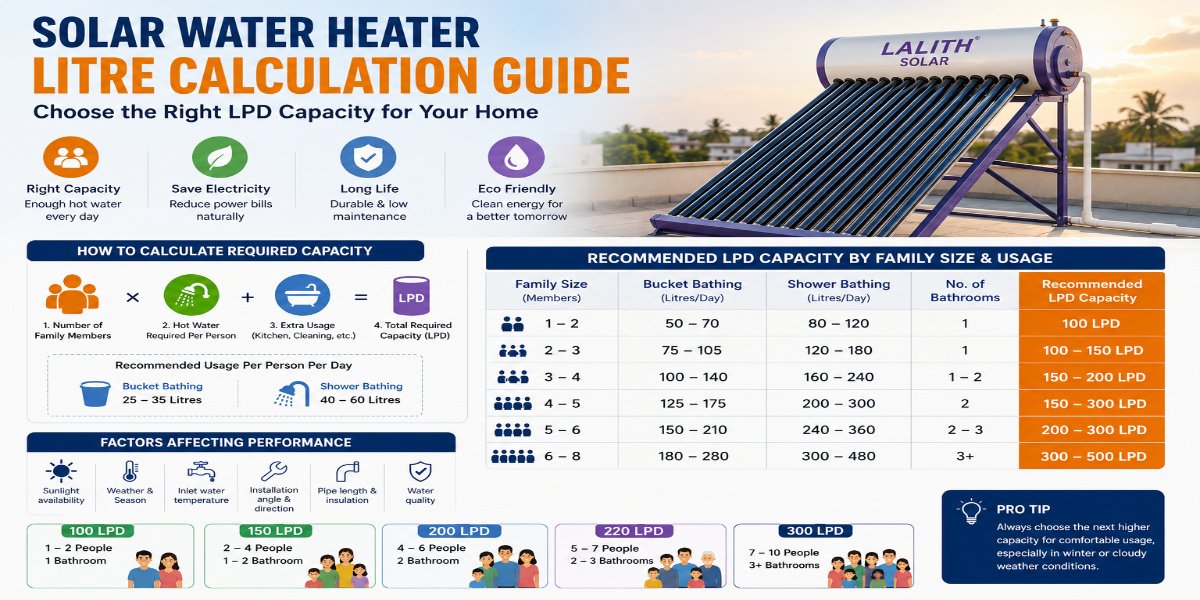
Learn how to calculate the correct solar water heater capacity for your home. Compare 100, 150, 200, 220 and 300 LPD models based on family size, bathrooms, bathing habits and hot-water usage.
How to Calculate Solar Water Heater Capacity in Litres
A solar water heater uses sunlight to heat water and store it in an insulated tank. The capacity of the system is normally mentioned in LPD, which means Litres Per Day.
For example:
- 100 LPD means approximately 100 litres of hot water can be supplied per day.
- 150 LPD means approximately 150 litres per day.
- 200 LPD means approximately 200 litres per day.
Selecting the correct capacity is important. A smaller system may not provide enough hot water, while an oversized system may cost more and require additional rooftop space.
This guide will help you calculate the right solar water heater capacity for your home, apartment, villa, hostel or commercial property.
What Does LPD Mean?
LPD stands for Litres Per Day.
It indicates the approximate quantity of hot water a solar water heater can produce and store under suitable sunlight conditions.
The actual hot-water output may vary depending on:
- Sunlight availability
- Weather conditions
- Water temperature
- Incoming cold-water temperature
- Installation direction
- Collector type
- Usage pattern
- Plumbing distance
- Tank insulation
- Hard-water scaling
LPD should therefore be treated as a practical capacity guide rather than a fixed daily guarantee.
Basic Solar Water Heater Calculation Formula
A simple calculation is:
Required capacity = Number of users × Hot water required per person
For bucket bathing, a practical estimate is:
25 to 35 litres per person per day
For shower bathing, a practical estimate is:
40 to 60 litres per person per day
Example 1: Bucket Bath
A family has four members.
4 people × 30 litres = 120 litres per day
A 150 LPD solar water heater would be a suitable choice.
Example 2: Shower Bath
A family has four members using showers.
4 people × 50 litres = 200 litres per day
A 200 LPD solar water heater would be more suitable.
Recommended Capacity Based on Family Size
| Family size | Bucket bathing | Regular shower use | Recommended capacity |
|---|---|---|---|
| 1–2 people | 50–70 litres | 80–120 litres | 100 LPD |
| 2–3 people | 75–105 litres | 120–180 litres | 100–150 LPD |
| 3–4 people | 100–140 litres | 160–240 litres | 150–200 LPD |
| 4–5 people | 125–175 litres | 200–300 litres | 150–300 LPD |
| 5–6 people | 150–210 litres | 240–360 litres | 200–300 LPD |
| 6–8 people | 180–280 litres | 300–480 litres | 300–500 LPD |
These figures are approximate. Choose a higher capacity when several people need hot water at the same time.
Quick Capacity Selection Guide
100 LPD Solar Water Heater
Suitable for:
- 2–3 people with bucket bathing
- 1–2 people with regular shower use
- One bathroom
- Small apartments
- Couples and small families
Common applications:
- Bathing
- Limited kitchen use
- Light daily hot-water requirement
150 LPD Solar Water Heater
Suitable for:
- 3–4 people with bucket bathing
- 2–3 people with shower use
- One or two bathrooms
- Medium-sized homes
- Small villas and apartments
This is a popular option for families with moderate hot-water consumption.
165 LPD Solar Water Heater
Suitable for:
- 4–5 people with controlled bucket usage
- 3–4 people with moderate shower use
- Homes requiring slightly more capacity than 150 LPD
- Two bathrooms with planned usage
A 165 LPD model provides an additional buffer without moving directly to a 200 LPD system.
200 LPD Solar Water Heater
Suitable for:
- 5–6 people with bucket bathing
- 4 people with regular shower use
- Two bathrooms
- Large families
- Villas, farmhouses and guest houses
It is also suitable when hot water is used for bathing, washing and kitchen cleaning.
220 LPD Solar Water Heater
Suitable for:
- 5–7 people
- Two or three bathrooms
- Families with mixed bucket and shower usage
- Homes requiring additional reserve capacity
- Light commercial applications
This capacity provides a useful buffer for heavy morning usage.
300 LPD Solar Water Heater
Suitable for:
- 7–10 people with controlled use
- 5–7 people with regular shower use
- Three or more bathrooms
- Large villas
- Guest houses
- Hostels
- Clinics
- Small lodges
Commercial users should calculate capacity based on actual daily hot-water demand rather than family size alone.
Step-by-Step Solar Water Heater Litre Calculation
Step 1: Count the Number of Daily Users
Include everyone who will regularly use hot water.
Example:
- Adults: 4
- Children: 2
- Total users: 6
Do not calculate based only on the number of bedrooms.
Step 2: Identify the Bathing Method
Bucket Bathing
Usually requires less hot water.
Estimated hot-water requirement:
25–35 litres per person
Shower Bathing
Usually consumes more water.
Estimated hot-water requirement:
40–60 litres per person
Bathtub Use
A bathtub may require significantly more water and should be calculated separately.
A home with bathtub usage may require a larger system or a backup heating arrangement.
Step 3: Add Kitchen and Utility Usage
Hot water may also be used for:
- Washing vessels
- Cleaning greasy cookware
- Laundry
- Floor cleaning
- Salon or clinic activities
- Guest usage
Add approximately 10–30 litres per day for light kitchen and utility use, depending on the household.
Step 4: Consider Simultaneous Usage
A family may have enough total daily capacity but still face shortages when several bathrooms are used at the same time.
Choose a larger capacity when:
- Two or more people bathe simultaneously
- Multiple bathrooms are connected
- Everyone uses hot water during the morning
- Guests frequently stay at the property
- Shower use is high
Step 5: Add a Safety Margin
After calculating the basic requirement, add a reserve of around 10% to 20%.
Example
A family requires 160 litres per day.
Adding a 15% margin:
160 + 24 = 184 litres
Recommended selection:
200 LPD solar water heater
This reserve helps during winter, cloudy weather and higher-than-normal usage.
Detailed Calculation Examples
Example 1: Three-Member Family
Usage:
- Three people
- Bucket bathing
- Light kitchen usage
Calculation:
3 × 30 litres = 90 litres
Add 10 litres for kitchen use:
90 + 10 = 100 litres
Recommended capacity:
100 LPD
Example 2: Four-Member Family
Usage:
- Four people
- Mixed bucket and shower bathing
- One kitchen
- Two bathrooms
Calculation:
4 × 40 litres = 160 litres
Add approximately 15 litres for utility use:
160 + 15 = 175 litres
Recommended capacity:
200 LPD
Example 3: Six-Member Family
Usage:
- Six people
- Mostly bucket bathing
- Two bathrooms
- Moderate kitchen use
Calculation:
6 × 30 litres = 180 litres
Add 20 litres for kitchen use:
180 + 20 = 200 litres
Recommended capacity:
200 or 220 LPD
Choose 220 LPD when all members bathe during the same period.
Example 4: Six-Member Family with Showers
Calculation:
6 × 50 litres = 300 litres
Add utility usage:
300 + 20 = 320 litres
Recommended capacity:
300–400 LPD
A 200 LPD model may not be sufficient for this usage pattern.
How Many People Can Use Each Capacity?
| Capacity | Approximate users | Suitable usage |
|---|---|---|
| 100 LPD | 2–3 people | Bucket bathing and light household use |
| 110 LPD | 2–3 people | Small family with slight extra reserve |
| 150 LPD | 3–4 people | Medium family and moderate usage |
| 165 LPD | 4–5 people | Controlled usage with additional reserve |
| 200 LPD | 5–6 people | Larger family and two bathrooms |
| 220 LPD | 5–7 people | Heavy family use and multiple bathrooms |
| 300 LPD | 7–10 people | Large families and light commercial use |
| 500 LPD | 12–18 people | Hostels, lodges and commercial applications |
Actual suitability depends heavily on shower duration and water-flow rate.
Factors That Affect Solar Water Heater Performance
Sunlight Availability
Solar water heaters perform best when collectors receive direct sunlight for most of the day.
Avoid installation under:
- Trees
- Water tanks
- Nearby walls
- Tall buildings
- Rooftop structures that create shade
Installation Direction
The collector should be positioned to receive maximum sunlight throughout the day. The correct orientation and tilt should be decided by a trained installer based on the property location.
Climate and Season
Water may heat faster during hot summer days and more slowly during:
- Winter
- Rainy periods
- Cloudy weather
- Heavy fog
A slightly higher capacity or electrical backup may be useful in locations with prolonged cloudy weather.
Inlet Water Temperature
Cold groundwater requires more solar energy to reach the desired temperature. Homes in colder locations may need more capacity than homes in warmer regions.
Hard Water
Hard water can cause mineral deposits inside:
- Tubes
- Collectors
- Pipes
- Storage tanks
Choose a model suitable for the local water condition and follow the recommended descaling schedule.
Length of Hot-Water Pipeline
Long pipelines may cause heat loss before water reaches the bathroom.
Use:
- Proper pipe insulation
- Shorter plumbing routes
- Correct pipe diameter
This improves efficiency and reduces water wastage.
ETC vs FPC Solar Water Heater
ETC Solar Water Heater
ETC means Evacuated Tube Collector.
It uses glass vacuum tubes to absorb solar heat.
Advantages
- Good heating performance
- Generally economical
- Lightweight system
- Suitable for many residential applications
- Easy tube replacement
Considerations
- Glass tubes require careful handling
- Water quality should be checked
- Maintenance may be needed in hard-water areas
FPC Solar Water Heater
FPC means Flat Plate Collector.
It uses a flat, insulated collector panel with metal tubes.
Advantages
- Strong and durable construction
- Suitable for pressurised systems when designed accordingly
- Long service life
- Good choice for villas and commercial properties
- No exposed glass vacuum tubes
Considerations
- Usually costs more than ETC
- Heavier structure
- Requires proper installation
- Rooftop load should be checked
Pressurised vs Non-Pressurised System
Non-Pressurised Solar Water Heater
Suitable for:
- Normal gravity water supply
- Overhead tank installations
- Standard residential use
The cold-water tank should normally be installed above the solar water heater to provide sufficient flow.
Pressurised Solar Water Heater
Suitable for:
- Pressure pumps
- High-rise villas
- Rain showers
- Multiple bathrooms
- Premium plumbing systems
Do not connect a standard non-pressurised solar heater directly to a high-pressure pump unless the manufacturer confirms compatibility.
Rooftop Space Requirement
The required space depends on:
- Capacity
- Collector type
- Number of tubes
- Tank size
- Installation angle
- Service access
The roof should be:
- Structurally strong
- Flat or properly supported
- Free from shade
- Accessible for maintenance
- Close to the hot-water pipeline
Keep sufficient space around the unit for servicing and cleaning.
Solar Water Heater Maintenance Tips
To maintain efficient performance:
- Clean dust from tubes or collectors regularly.
- Inspect the plumbing for leakage.
- Check the supporting stand for rust or damage.
- Clean the storage tank as recommended.
- Remove mineral scale in hard-water areas.
- Inspect insulation on hot-water pipes.
- Ensure the collector is not shaded.
- Arrange professional servicing periodically.
- Replace damaged tubes immediately.
- Check safety valves in pressurised systems.
Common Mistakes to Avoid
Choosing Only by Family Size
Two families with the same number of members may have very different water usage.
Always consider:
- Shower or bucket use
- Number of bathrooms
- Bath duration
- Guest usage
- Kitchen requirements
Buying a Very Small Capacity
A small system may save money initially but can lead to daily hot-water shortages.
Ignoring Water Pressure
Check whether the model supports your pressure pump or rain-shower system.
Installing in a Shaded Area
Even a high-capacity unit will perform poorly without sufficient sunlight.
Ignoring Hard-Water Conditions
Select the correct tank and collector type based on local water quality.
Frequently Asked Questions
Is 100 LPD enough for four people?
It may be enough only when usage is very controlled and bucket bathing is limited. For comfortable use by four people, 150 LPD is generally safer.
Is 150 LPD enough for five people?
It may be sufficient for controlled bucket bathing. For regular shower usage or two bathrooms, consider 200 LPD.
Is 200 LPD enough for six people?
It is generally suitable for six people using buckets or moderate hot-water quantities. For regular showers, choose a higher capacity.
Can solar-heated water be used in the kitchen?
Yes. It can be used for washing utensils and cleaning, subject to proper plumbing.
Will the system work during rainy weather?
Heating performance reduces during continuous cloudy or rainy conditions. Some models include or support an electrical backup heater.
Does a higher LPD mean hotter water?
No. LPD indicates water quantity, not necessarily temperature. Water temperature depends on sunlight, collector efficiency, season and system design.
Can a solar water heater work with a pressure pump?
Only if the model is designed for pressurised operation. Confirm the pressure rating before installation.
Simple Buying Recommendation
Choose:
- 100 LPD for 2–3 people
- 150 LPD for 3–4 people
- 200 LPD for 5–6 people
- 220 LPD for 5–7 people with heavier use
- 300 LPD for 7–10 people or multiple bathrooms
Move to the next higher capacity when your family uses showers, has multiple bathrooms or requires hot water simultaneously.
Why Buy a Solar Water Heater?
A properly selected solar water heater can offer:
- Reduced electricity consumption
- Lower monthly power bills
- Renewable energy usage
- Daily hot-water convenience
- Long service life
- Low running cost
- Reduced dependence on electric geysers
- Environment-friendly water heating
Conclusion
The correct solar water heater capacity should be selected based on more than family size. Consider how many people use hot water, whether they use buckets or showers, the number of bathrooms, kitchen requirements, water pressure and seasonal conditions.
A practical calculation is:
Number of users × hot-water requirement per person + utility usage + safety margin
For most homes, choosing the next higher available capacity provides better comfort and prevents hot-water shortages.
At LG Shopnest, customers can compare solar water heaters from brands such as Lalith Solar, Supreme Solar, V-Guard and Sudarshan Solar. Select the capacity according to your home, usage pattern, water condition and installation requirements.